Choosing a golf ball: compression, spin and cover
The ball is the only piece of equipment you use on every single shot, and the one most golfers choose by price or by what they found in the trees. Here is what the specifications mean and which of them will actually change your score.
Written and maintained by the Golf Game Bet Calculator team, who build the scoring engine this site runs on. Last reviewed .
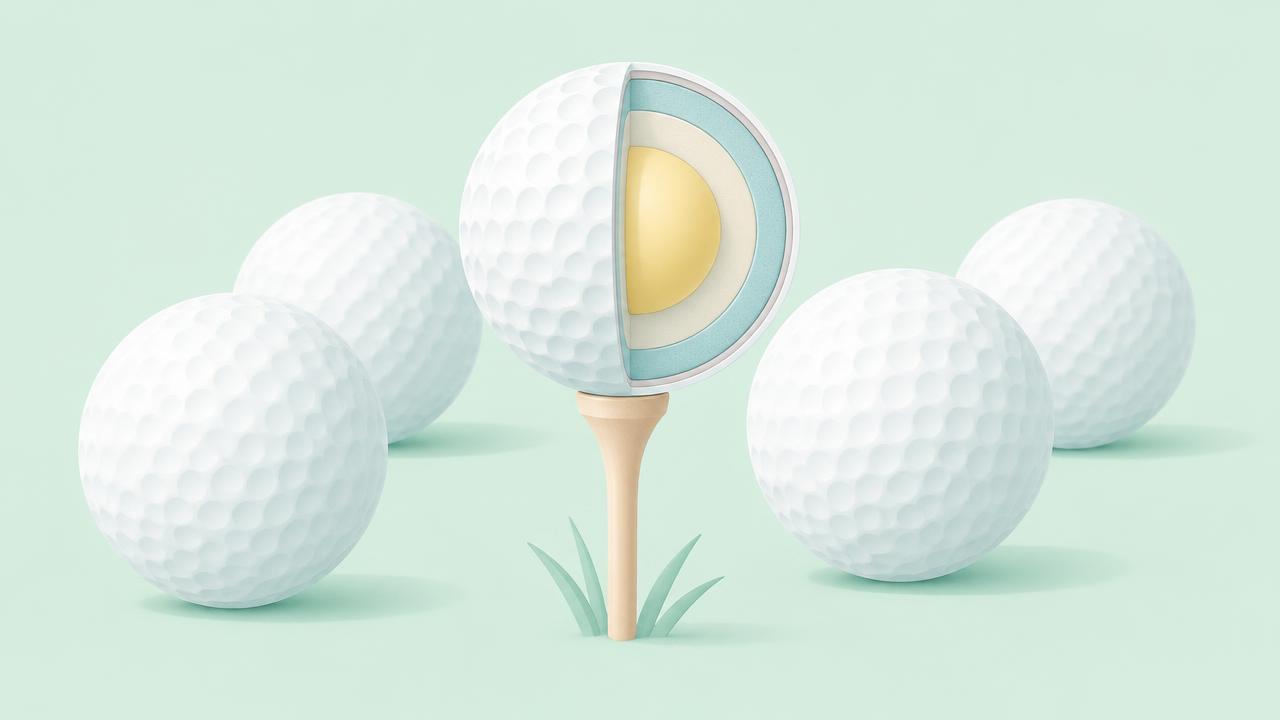
Construction: how many layers, and why
- Two-piece: a large solid core with a durable cover. Low spin, long off the driver, hard to stop on a green. The classic distance-and-durability ball.
- Three-piece: core, mantle layer and cover. The mantle lets the ball stay low-spin on the full-speed driver strike while the soft cover grabs on wedges. This is where most good all-round balls sit.
- Four and five-piece: extra mantle layers tuned to different impact speeds, giving finer separation between driver spin and iron spin. Real, but a small effect for anyone who is not striking the ball consistently.
Cover material: the decision that matters most
Urethane covers are soft and grippy. They generate meaningfully more spin on pitches, chips and full wedges, which is what lets a shot check on the green rather than releasing to the back fringe. They cut and scuff more easily and cost more.
Ionomer (often branded Surlyn) is harder and far more durable. Less greenside spin, typically slightly lower driver spin, and a firmer feel off the putter. If you lose several balls a round, this is the sensible choice — no urethane ball is worth its price at the bottom of a lake.
Compression and swing speed
Compression is roughly how much the ball deforms at impact — low numbers around 50 to 70, high numbers around 90 to 100. The popular claim is that a slow swinger loses distance with a high-compression ball. The honest version is that the distance difference is small for most players; the difference infeel is large. A low-compression ball feels soft and hot at moderate speeds; a firm ball feels dead unless you deliver real speed to it.
- Under about 85 mph driver speed: low compression, soft feel.
- 85–100 mph: mid compression covers almost everyone.
- Above 100 mph: firmer balls hold up better and spin less off the driver.
Matching ball type to player profile
| Player profile | Suggested construction | Cover |
|---|---|---|
| Beginner, loses several balls a round | Two-piece, low compression | Ionomer |
| Mid-handicap, breaks 90-100 | Three-piece, mid compression | Ionomer or value urethane |
| Low-handicap, scores with wedges | Three or four-piece, mid-high compression | Urethane |
| Fast swinger seeking control off the tee | Multilayer, firmer compression | Urethane |
| Senior or slower swing seeking distance | Two or three-piece, low compression | Ionomer or soft urethane |
Starting points only — always confirm with a short on-course test rather than the box alone.
Spin: where you want it and where you don't
You want low spin off the driver — excess backspin balloons the flight and costs carry, and side spin exaggerates the curve. You want high spin on wedges so approach shots stop. Multilayer urethane balls exist precisely to deliver both, and this is the one genuine performance benefit worth paying for.
If you slice badly, a low-spin two-piece ball will curve less. It will also stop less on the greens. For a golfer losing shots to tee-shot penalties rather than to approach shots, that is a good trade. For more on aiming to reduce the cost of a dominant miss off the tee, see the course management guide.
Weather and conditions
- Cold weather: everything firms up and carries shorter. A softer ball feels less like hitting a stone and holds a bit more speed.
- Wind: lower-spin balls fly flatter and hold their line better.
- Firm, fast greens: urethane earns its money — you need the ball to check.
- Soft, receptive greens: the cover matters much less, since the ball stops anyway.
How to actually test a ball
- Pick two candidates and buy a sleeve of each.
- Test them from 40 yards, 100 yards and on the putting green — not on the driving range.
- Judge by how the ball behaves after it lands: does it check, one-hop-stop, or release?
- Compare feel off the putter over ten putts. Putting feel is subjective and it matters.
Then commit. Playing a different ball every round makes it impossible to learn how far your wedges fly or how much a chip runs out, and that knowledge is worth more than any ball model difference. For wedge distance calibration drills, see the putting and short game guide.
Dimple pattern and flight — a minor but real factor
Dimple count and pattern (typically 300-500 dimples) affect lift and drag through the air, which is why two balls with identical construction can still fly slightly differently in wind. This is a second-order effect compared with cover and compression, and not something worth choosing a ball over on its own — but it explains why a ball that felt great on a calm day can behave differently in a strong crosswind.
Rules and etiquette worth knowing
- One Ball condition: in most casual golf you may change model between holes. Some competitions apply the One Ball Rule requiring the same brand and model for the whole round — agree which applies before a money game starts.
- Mark your ball. A dot pattern with a marker prevents the argument that ruins a bet: two identical balls in the same fairway is a lost-ball ruling waiting to happen.
- Playing a wrong ball costs the hole in match play and two strokes in stroke play.
A short buying summary
- You lose 3+ balls a round: durable two-piece ionomer. Spend the money on lessons.
- You break 100 and keep the ball in play: a soft three-piece ionomer or a value urethane ball.
- You break 85 and score with your wedges: a three-piece urethane tour ball.
- You play in wind and firm conditions: lower spin off the tee, urethane cover.
Frequently asked questions
Does the golf ball I play actually affect my score?
Less than club fitting or practice time, but it is not negligible. Cover material has the biggest measurable effect: a urethane cover generates meaningfully more spin on wedge shots, which helps the ball stop near the pin. Compression mostly changes feel rather than distance for the average player. Picking one ball and learning its exact yardages matters more than the specific model.
What is the difference between a two-piece and a three-piece ball?
A two-piece ball has a large solid core and a durable cover, producing low spin, long carry off the driver, and durability, but little stopping power on greens. A three-piece ball adds a mantle layer between the core and cover, which keeps driver spin low while letting the softer cover generate high spin on wedge shots.
Should high handicappers play a cheap ball?
Usually yes. If you regularly lose three or more balls per round, a durable two-piece ionomer ball is the sensible choice regardless of skill level, because a premium urethane ball lost in the water or trees provides no benefit. Once lost-ball rate drops and short-game skill improves, upgrading to a spinnier ball starts to pay off.
What does ball compression actually mean?
Compression describes how much the ball deforms at impact, typically rated from around 30 (very soft) to over 100 (very firm). Lower compression balls feel softer and are easier to compress at slower swing speeds; higher compression balls feel firmer and are designed for faster swings. The distance difference between compression levels is smaller than marketing suggests for most amateur swing speeds.
Can I switch golf ball brands between holes in casual play?
In most casual and even many club competitions, yes — there is no rule against changing ball model between holes unless the One Ball Rule is specifically in effect for that competition. Some tournaments require the same brand and model for all 18 holes. Agree which rule applies before a money game starts to avoid disputes.
Does a low-spin ball help if I have a slice?
Generally yes for the tee shot. A low-spin two-piece ball curves less off the tee because sidespin is the mechanism that turns a mis-hit into a slice, so reducing overall spin reduces the size of the curve. The trade-off is less greenside stopping power, which is usually an acceptable cost for a golfer losing more shots to errant drives than to approach shots.